It Was Golden
by Amra Brooks
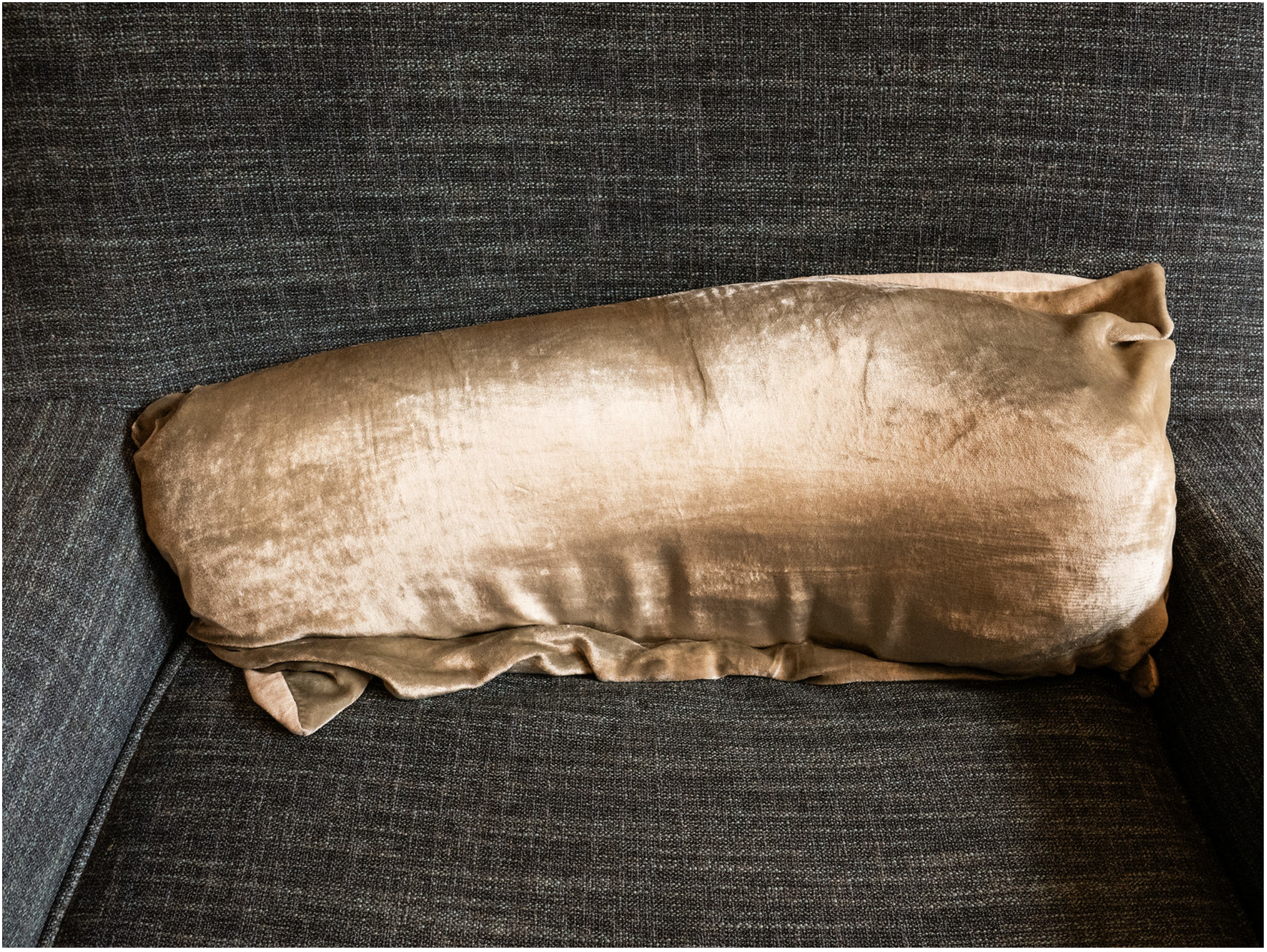
Jessica Watson, champagne pillow, pigment print (digital), 2023. Courtesy of the artist.
It Was Golden
Amra Brooks | Sept/Oct 2026 | Issue 55
ESSAY
I invited Wyatt over for dinner. I made a curry that I had made a thousand times and that night it turned out terrible. We stayed up late talking. My insides tingled. It had been a long time since I had been with a man. He had vibrant green eyes, brown curls, a beard. He wore faded jeans and cowboy boots, soft old t-shirts and flannels. He told me about growing up in rural Maine, a place that was not a town, just a route number. His family had stayed in that place for generations. His father was Mi’kmaq and had taught him how to heal wounds in a way that was passed down from his ancestors. He wasn’t allowed to show me or tell me how, but I instantly felt safe knowing if there was an accident he could save me. I imagined bleeding in the snow on the side of the road and his touch taking the pain away. Wyatt had wanted to be a priest when he was younger. I couldn’t imagine wanting this, yet I fetishized life in a convent that I read about in books and saw in films. Ecstasy and white walls. Twin beds and rising in the dark. Hours on your knees with a rosary. Later in our relationship he joked that I said he had good genes that night, as if I was sizing him up to father my children.
He asked me to go swimming at a lake with him the following weekend. I laughed, thinking there are no fucking lakes in LA, and then I let this guy from Maine show me the lake. I wore flip flops and we hiked through dry brush and crumbling hillside to a man-made lake somewhere east of Los Angeles and had a picnic. I made tofu and avocado sandwiches and we ate chips in the sun. We swam together and then took a long walk on the strange shore line. I locked my arm in his and he drove me home in his 1980’s green Honda. I was seeing my city through his eyes and it started to feel like a different place. One that wasn’t haunted.
He came upstairs into my apartment and we watched The Misfits with Marilyn Monroe and Montgomery Clift in my bedroom. Before she tried to free the horses, Wyatt kissed me hard. His eye teeth were pointed and slightly protruded like mine, and they hit against my mouth. His body pushed me into the mattress. I liked his force but was also surprised by it. It made me wonder if another woman had told him that she liked it that way, or if the pious part of him that was closed up for so long unravelled.
Wyatt’s house was on a hill, a small box behind another, barely a house. There were stairs from the street leading up to the first one and another set to the one behind. Each time I climbed I was breathless when I reached his door, thinking I was merely out of shape. I would walk up all the steps slowly and without noise so he wouldn’t hear me coming, so I would not seem out of breath when I would finally knock. Sometimes I would have to sit and wait for my breath to return. I carried this secret. I wondered what was wrong with me for not being able to handle the small amount of exertion.
The first time he had me over for supper, we sat on either side of a patio table on folding chairs in his tiny kitchen. We ate some kind of stir-fry and everything seemed delicious and salty. He ate like he kissed, hard and fast. A few minutes after he sat down, the meal he had invited me to was over. I couldn’t really believe the furniture: bulbous and over-stuffed velour, rust and emerald green. The carpet was mangy and wild. He wanted me to live there in that tiny place with him. It seemed everything, including the television, which you had to kick every few minutes to make the picture come back into focus, was found on the sidewalk. The sun bleached the pictures he hung on his walls. “The more faded, the better,” he said. The yard was a steep incline behind the building. No grass. Just dirt and weeds and a huge olive tree. There should have been bougainvillea but there wasn’t. A few old cacti were coming around the far wall of the beige house. He liked to sit out there in the mornings and smoke with his coffee. In the afternoon we’d play backgammon and I got angry with him for winning. He didn’t say, “Women are so cute when they are angry,” but in my mind he did, and it made me more angry. He laughed when I refused to play another game.
There were times that summer that were so hot we couldn’t have a stitch of clothing on and the door would stay open. We heard his neighbor’s bad hard-core band practicing and late into the weekend nights mariachi music would echo through the canyon. I wore slip dresses that I hadn’t worn since college, my hips shrinking. It made him insecure that I had been with women before him. I bought him an oscillating fan at CVS. These kinds of comforts didn’t cross his mind. It was the best gift he had ever received. It never rained.
We exchanged messages on MySpace all day while he was at work. I waited eagerly for his next message to come in each time I responded. Witty one liners bounced between us. He was a combination of earnest and sarcastic, brilliant and humble. I was fascinated with stories of his upbringing that was so different from mine. In December he invited me to come home with him for the holidays. He told me he loved me. When we had sex we didn’t use protection. He said he was very good at pulling out and had never made a mistake. After trying this method for a couple weeks I took the morning after pill one night, convinced I had gotten pregnant. Flashbacks of my teenage years with Lyle and my abortion still vivid. “What if I’m pregnant,” I said. “Would that really be so bad?” he asked. We spoke to each other like we were at the start of a long life.
I had never been to Maine before. It was a place I always romanticized because of its lost wealth and industry, a place of tradition, ghosts, abandoned houses, secret islands and calm water. It still seemed open and uncharted. We got cheap airline tickets and drove all the way to the Canadian border from Boston at night in a blizzard. I had never driven in snow like this. It was like we were in Star Wars flying a ship through space, asteroids zooming by. I kept imagining us freezing to death on the side of the road. I didn’t know what Wyatt meant when he talked about “taking the ditch.” My body braced for the off road crash into the icy trench.
His parents’ house was on a lake. It was golden; the wood and the way light hit it at the end of the day. No place had ever felt so warm. It was the way they hugged me, as if I’d always been there. Wyatt’s two-year-old nephew kept kissing my shoulders and rubbing my belly. When kids or animals were drawn to me, it meant more than winning over adult humans. It was like acing a test with a reward in cuddles. The house had only one bedroom. We slept in the freshly polyurethaned basement and breathed in the coating on the pine. I could taste the chemicals. I imagined my skin absorbing them. The second night I asked to be moved into his mother’s pottery shed because I couldn’t stand the smell. The heat had to be turned on five hours before we went to sleep in order for the shed to get warm enough. I was relieved to be alone with him. I didn’t care that we had to pee in a bucket. We removed each other's clothes without words.
The lake was frozen and I didn’t know how to walk on ice. I was afraid to lift my feet at all. I slid with each step and this made Wyatt laugh. I couldn’t imagine it was ever warm enough to swim here, that northern Maine was ever warm. But it really wasn’t Maine after all, it was Canada that his parents lived in now. Their house was built just over the border.
When I got the job offer from the college in Pennsylvania, I only had three days to make a decision. Classes began in four weeks. Wyatt came with me on the red eye. My cat, The Bat, who had just had a tumor removed from his toe was quiet the whole way, just two little mews that seemed pathetic and lonely with the drown of the jet engine and I wondered what he would do if he knew we were in the sky. Flying.
Wyatt got a job in New York three hours away from the college. He came out on weekends to a house that was too expensive for me to rent alone, but looked like a place I wanted to live with him. The stove was turquoise, the toilet peach, and there was a formica bar in the basement. I thought if it felt like home he would stay.
We had flip phones and a land line. I still rented video tapes at the remaining Blockbuster. Every night Wyatt called. “Hi Babe,” he said like he was holding his breath. And before we hung up, “Love you.” All week I looked forward to seeing him, and then I had that Sunday feeling worse than ever when he prepared to leave. He folded his pants and put them into a small empty suitcase from a thrift store.
I saw a therapist when it ended. She was a New Age grandma type. She gave me sound baths and gong washes, and played singing cups and the harp. I would close my eyes and imagine my chest opening so the sound could clear out the sadness. She said it was a past life connection that made the break up so difficult. I imagined us riding horseback through a field in medieval robes like Robert Plant in Song Remains the Same and thought, yes. Wyatt always said that it came down to the fact that we were too similar. Or maybe we had been twins in another life. At times it felt like we could see through each other’s eyes.
When Wyatt broke up with me, he was lying in bed, seeming kind of paralyzed. I grabbed his hand, trying to make things lighter. “I love your hands,” I said. But did I? His nails were long and ragged for plucking his guitar strings. He never touched me anymore. They weren’t especially strong looking. The centers were meaty. His expression looked pained. He opened his lips and the cliché spilled out, “I love you, but I’m not sure I’m in love with you anymore.” What would come next was pellucid. I thought back to the 16-hour drive to Northern Maine and Canada just four months earlier, us thinking of names for the puppy we had decided to get. I wasn’t sure if it was his idea to get one now to prepare us for the baby I wanted to have, like practicing, or if it was to delay my increasing desire to become a mother. He said I don’t know what my family would do if we ever broke up. At the time it felt like he was trying to pay a compliment, but even then, I had wondered why he said it. They were the family I always wanted. His grandmother only ate sweets and told me she would visit me after she was dead so she could still spend time with me. Wyatt and I decided to name the puppy Bertrand. A name few could pronounce correctly. One that seemed far too serious and absurd for this tiny creature who looked like a small black Wookiee.
It was still light out, the beige pleated curtains that came with the rented house were closed in the bedroom, the light seeping through. The life I had envisioned for us was crumbling right there. Three-pound Bertrand in his pen in the kitchen. I remember screaming and throwing all his belongings into the hallway, clothes everywhere.
During our first winter I had been diagnosed with a rare lung disease. I saw the pulmonologist every six weeks. He listened to my breathing with a cold stethoscope and I wondered what disease sounded like. I had been tapering off of steroids for a few months. My lungs were healing. I felt the side effects waning at long last. My face was less puffy; I was no longer ravenous all the time. The soles of my feet burned less frequently. After we stopped having sex, I no longer would undress in front of him. I sometimes cried silently in bed after he fell asleep spooning me. I thought about the night in the shed in Maine, his hands on my naked back, the way he turned my body and grabbed my hips.
He left in his rattling brown station wagon, disappeared from the year that I had waited to be on the other side of. I pleaded with him to sleep on the couch, hoping that something would be different in the light of a new day. He put the things I had thrown on the ground into the car. Tears in his eyes. Slam. The 1950s saucer light illuminating the emergency. Our puppy a witness to what felt like a crime scene. My body sliding down the kitchen wall.
Amra Brooks’ memoir Mother Is a Place was released by Dopamine Books on September 15, 2026. Her novella California was published by Cali Thornhill DeWitt’s Teenage Teardrops. Her writing has appeared in Artforum, Inventory, Khôra, Printeresting, Entropy, This Long Century, and many other publications. She grew up in California and has taught creative writing at the University of California in Santa Cruz and San Diego, and Muhlenberg College. She now lives in Providence, Rhode Island and is a Professor at Stonehill College where she directs the creative writing program and runs the Raymo Literary Series. She offers manuscript consultations, writing coaching, private writing workshops, as well as workshop collaborations with Corporeal Writing. She has a BA from Sarah Lawrence College and an MFA from Milton Avery School for the Arts at Bard College.
Jessica Watson has exhibited her work in venues including the Alice Austen House, Larissa Goldston Gallery, Art in General, La MaMa, Massimo Audiello Gallery, the CMCA in Rockport, Maine, and the UNR Sheppard Fine Arts Gallery in Reno. She was a resident at the Lower Manhattan Cultural Council’s Workspace Program in 2005. Her images has been featured in Dear Dave Magazine, New England Review and online on the Women in Photography and The Invisible Project websites. Her work has been reviewed in the New York Times, the Village Voice and in Susan Bright’s critical essay A Guided Tour. She holds a BA from Wellesley College and a MFA from Bard College’s Milton Avery Graduate School for the Arts. She lives in Providence, RI.